Tuesday, May 7, 2013

King George had his own State Controlled Media too

On the website for McGraw-Hill, there is an interesting poll question available for now:

#1: Fearing the power of an unrestricted printing press during 1476-1776, the British Crown:

A) Required individuals to obtain a license before printing materials.

B) Forced printers to deposit large sums of money in the form of bonds.

C) Made it a crime to criticize the government in print.

D) All of the above.

D is the right answer, let it be stated. Trying to find information from monarchical decrees that's centuries old, on the internet, can be quite an infuriating task. But I was able to dig up the 1586 Star Chamber Decree, which states among other things, this:

no presses were to be set up outside the City of London

The Star Chamber Decree of 1637 was just as bad:

I Imprimis, That no Person or Persons whatsoever shall presume to Print or cause to be Printed, either in the Parts beyond the Seas, or in this Realm, or other his Majesty's Dominions, any Seditious, Schismatical, or offensive Books or Pamphlets, to the scandal of Religion, or the Church, or the Government, or Governors of the Church and State, or Common-wealth, or of any Corporation, or particular Person or Persons whatsoever, nor shall import any such Book or Books, nor sell or dispose of them, or any of them, nor cause any such to be Bound, Stitched, or Sowed, upon Pain of he or they

It goes on from there. Note that last line: "upon pain of he or they". If you didn't print what the state wanted you to, they hurt you physically! This was during the reign of Charles I, who was such a dictator that they came up with the Grand Remonstrance in 1641, and ended up beheading the tyrant. Much of what he did they loosened, but not all of it.

Finally, the Licensing of the Press act of 1662, held the long title of "An Act for preventing the frequent Abuses in printing seditious treasonable and unlicensed Bookes and Pamphlets and for regulating of Printing and Printing Presses". This act was in force throughout the Colonial and Founding eras.

I read through some of them, I am fairly sure there were also other decrees and parliamentary acts which further entrench this power within government at the time. Another aspect of how the King controlled the early press was financially. The first newspaper published in America was the The Boston News-Letter, which was bought and paid for by the British government. The News-Letter was a Loyalist paper. Looking at some of the "big names" associated with the News-Letter, two stand out: Margaret Draper and Bartholomew Green - both of whom were loyalists.

With this level of tyranny imposed upon people who wished to state their beliefs honestly, it's no wonder that the First Amendment states what it does. The Founders wanted freedom of the press because they knew what an unfree press looked like and how powerful it was. That's why they got together in their Committees of Correspondence, in part, to educate each other with the truth. They knew the press was lying to them. Just like we have today. Except that there really aren't all of these decrees in place today. We have a free press, and it has freely chosen progressivism. It chooses to lie to us of its own free will.

Generally speaking, the role of journalism and the press in support of tyrants historically has been woefully under-explored.

http://tinyurl.com/d73of9o

Friday, May 3, 2013

The Century of the Self - a good place to look if you want to understand progressivism

If you want to understand progressivism, the BBC's documentary called "The Century of the Self"(CotS) is a surprisingly good place to start. Not just in what it does say, but in what it does not say and does not emphasize greater. Unfortunately, an accurate watching of CotS requires a certain level of built in knowledge. Much more than I could or will cover in one blog posting, for example, CotS mentions Woodrow Wilson as well as the CPI. That's beyond the scope of this blog posting to go in-depth, but I have covered both extensively and made plenty of information freely available for you to have access to. Any original sources that you come across, feel free to take them and do with what you wish.

I am coming up on the tail end of my recording of Walter Lippmann's book "Public Opinion" which means that much of the notes I have made regarding some of the things I have seen I will be covering in the coming days and weeks, but I do not want to leave the sole impression that I lay the blame squarely at Lippmann's feet. The corruption of the press goes wide and deep, well before Lippmann's tenure(and since), yet his importance cannot be ignored all the same. I'll give you two examples as a reference point not just for my readers, but for my own purposes.

1: John Dewey is considered the "Father of Modern Education", but that doesn't mean you can lay 100% of the blame at his feet either. John Dewey held Horace Mann in a very high regard, yet Horace Mann wrote the following: "We, then, who are engaged in the sacred cause of education, are entitled to look upon all parents as having given hostages to our cause". While there is a clear relation, this highlights that the corruption of education happened at least in part, before Dewey.(and of course, since)

2: In Lippmann's own writing, he points out the following: (page 40)

"Major Cointet, had invented a method of calculating German losses which obviously produced marvelous results. Every fortnight the figures increased a hundred thousand or so. These 300,000, 400,000, 500,000 casualties put out, divided into daily, weekly, monthly losses, repeated in all sorts of ways, produced a striking effect. Our formulae varied little: 'according to prisoners the German losses in the course of the attack have been considerable' ... 'it is proved that the losses' ... 'the enemy exhausted by his losses has not renewed the attack' ... Certain formulae, later abandoned because they had been overworked, were used each day: 'under our artillery and machine gun fire' ... 'mowed down by our artillery and machine gun fire' ... Constant repetition impressed the neutrals and Germany itself, and helped to create a bloody background in spite of the denials from Nauen (the German wireless) which tried vainly to destroy the bad effect of this perpetual repetition."

Which is exactly what the media did during the Iraq war. They bombarded us with this exact perpetual repetition. Lippmann didn't make this up. This is a good example of how the pen is mightier than the sword.

Yet Lippmann is quoted twice in Bernays' book Propaganda. If it weren't for the fact that Bernays left journalism to help Wilson with his propaganda, then go on to do propaganda for corporate america, he might very well have become the Father of Modern Journalism himself, instead of Lippmann. Even as an old man, you can see by watching BBC's documentary how sly and crafty the guy was.

This gets at point 1 of "The Century of the Self": It completely omits the fact that Edward Bernays was himself a journalist. It can't help but note that he had journalist friends because of the Torches of Freedom incident, but it never specifically states that that's initially what Bernays did. He was a journalist. That's how he was picked up by the CPI. Wilson's Committee for Public Information heavily employed members of the press.

So in this instance, the BBC is itself relying upon the tactics of Edward Bernays in doing a documentary about Edward Bernays. That's quite an interesting thing, isn't it? How different would the BBC's reporting have to be if the BBC incorporated the journalist's role in crowd control? One study even points out how the power to omit information gives journalists a huge amount of overall power. This includes CotS. By omitting Bernays' days as a journalist, the BBC successfully kept themselves out of examination. If the press were ever seriously examined, I do believe there is at least a potential for mass unrest. I do not think it would lead to violence, but there's no question that we have been betrayed by those who are supposed to be defending us; the "free press". And in that, there would be much anger if it were ever widely known.

Second, while the CPI is mentioned, this documentary largely glosses over government propaganda and sticks with the usual media formula of how evil and rotten the corporation is. The corporation is hardly an angel in any equation and in quite a large amount of instances, they're completely indefensible. However, how different would the BBC's reporting have to be if the BBC incorporated government propaganda efforts for the problems of peace? A phrase, which they even incorporate into their very own documentary!(Bernays uses the phrase) Once again, highlighting how the BBC is itself relying upon the tactics of Edward Bernays in doing a documentary about Edward Bernays.

Which is what I meant at the outset of this posting. You need a certain level of built in knowledge for a more accurate viewing of CotS. But once you have that information, which it has been my intent to give you, you can then begin to see how CotS is a great prep into the mindset of progressives.

Though you have to be looking for it, the BBC does inevitably swerve into the journalists' role in crowd control. They clearly don't want to discuss it. But it's right there in the documentary. The Torches of Freedom Incident simply could not have happened without the help of sympathetic figures in the press. This is probably the easiest place for anybody to see and then stop and ask themselves "hey wait, there's clearly something not right with that", and then end up asking even more questions.

http://tinyurl.com/cgqcbzx

Thursday, May 2, 2013

The ideology of journalists - progressivism

Arguably the most distinct and identifying feature of Progressivism is their complete faith and trust in bureaucratic despotism. One can say "the media are virtually never critical of the federal government's various departments" as an observation of reporting, but Walter Lippmann makes an interesting proposal in his book Public Opinion: (page 330)
The newspaper deals with a multitude of events beyond our experience. But it deals also with some events within our experience. And by its handling of those events we most frequently decide to like it or dislike it, to trust it or refuse to have the sheet in the house. If the newspaper gives a satisfactory account of that which we think we know, our business, our church, our party, it is fairly certain to be immune from violent criticism by us. What better criterion does the man at the breakfast table possess than that the newspaper version checks up with his own opinion? Therefore, most men tend to hold the newspaper most strictly accountable in their capacity, not of general readers, but of special pleaders on matters of their own experience.

Rarely is anyone but the interested party able to test the accuracy of a report. If the news is local, and if there is competition, the editor knows that he will probably hear from the man who thinks his portrait unfair and inaccurate. But if the news is not local, the corrective diminishes as the subject matter recedes into the distance. The only people who can correct what they think is a false picture of themselves printed in another city are members of groups well enough organized to hire publicity men. Now it is interesting to note that the general reader of a newspaper has no standing in law if he thinks he is being misled by the news. It is only the aggrieved party who can sue for slander or libel, and he has to prove a material injury to himself. The law embodies the tradition that general news is not a matter of common concern, 1 except as to matter which is vaguely described as immoral or seditious.

But the body of the news, though unchecked as a whole by the disinterested reader, consists of items about which some readers have very definite preconceptions. Those items are the data of his judgment, and news which men read without this personal criterion, they judge by some other standard than their standard of accuracy. They are dealing here with a subject matter which to them is indistinguishable from fiction. The canon of truth cannot be applied. They do not boggle over such news if it conforms to their stereotypes, and they continue to read it if it interests them.

Footnote 1 The reader will not mistake this as a plea for censorship. It might, however, be a good thing if there were competent tribunals, preferably not official ones, where charges of untruthfulness and unfairness in the general news could be sifted. Cf. Liberty and the News, pp. 73-76.

When progressives use the word "common", they traditionally mean government. Lippmann makes it clear that he means that here, and points out that he's not calling for censorship.

So what is a competent tribunal? Its a body of experts. It's progressivism. A group of unelected bureaucrats sitting around making decisions for someone else. He says he would prefer that they not be official(again, meaning government), but if it should be done by government, no big deal.

This isn't his only call for more unelected bureaucrats. Chapter 27 Intelligence Work is all about unelected bureaucrats. Some good, some bad. He's not blind about it being a silver bullet answer, but he clearly prefers a network of bureaucrats collecting information.

This is the Father of Modern Journalism. They love this guy. At Harvard, they have a monument to him. That's their journalism school. They know how important and influential he was.

http://tinyurl.com/cx5hsr6

Wednesday, May 1, 2013

How did journalists make themselves associates of the state?

Back in 2011, I wrote about how George Creel's plan with the Committee for Public Information (CPI) was to make journalists associates of the state. Here is in part what he wrote: (page 17)
With the nation in arms, the need was not so much to keep the press from doing the hurtful things as to get it to do the helpful things. It was not servants we wanted, but associates. Better far to have the desired compulsions proceed from within than to apply them from without.

And from page 18:

My proposition, in lieu of the proposed law, was a voluntary agreement that would make every paper in the land its own censor, putting it up to the patriotism and common sense of the individual editor to protect purely military information of tangible value to the enemy. The plan was approved and, without further thought of the pending bill, we proceeded to prepare a statement to the press of America that would make clear the necessities of the war-machine even while removing doubts and distrusts.

This begs an obvious question, how can the journalists defend us from ambitious men in government if they don't even keep an eye out and defend themselves(or their institution) from ambitious men in government? First off, Creel was himself a journalist, so who better for government to hire than a fellow journalist to do all of this co-opting. Second, Creel was not the only one. The CPI was virtually staffed wall to wall with journalists. Well, if the government is going to hire that many journalists, surely we can trust it, right?

There's still a lot of gaps to fill in here. What was going on on the ground? Why would the journalists, those who are supposedly our defenders of liberty, let this happen? Walter Lippmann gives us a good idea of how this happened. The journalists got lazy. In chapter 23 of Lippmann's "Public Opinion", he writes the following: (page 338)

ALL the reporters in the world working all the hours of the day could not witness all the happenings in the world. There are not a great many reporters. And none of them has the power to be in more than one place at a time. Reporters are not clairvoyant, they do not gaze into a crystal ball and see the world at will, they are not assisted by thought-transference. Yet the range of subjects these comparatively few men manage to cover would be a miracle indeed, if it were not a standardized routine.

Newspapers do not try to keep an eye on all mankind. They have watchers stationed at certain places, like Police Headquarters, the Coroner's Office, the County Clerk's Office, City Hall, the White House, the Senate, House of Representatives, and so forth. They watch, or rather in the majority of cases they belong to associations which employ men who watch "a comparatively small number of places where it is made known when the life of anyone... departs from ordinary paths, or when events worth telling about occur. For example, John Smith, let it be supposed, becomes a broker. For ten years he pursues the even tenor of his way and except for his customers and his friends no one gives him a thought. To the newspapers he is as if he were not. But in the eleventh year he suffers heavy losses and, at last, his resources all gone, summons his lawyer and arranges for the making of an assignment. The lawyer posts off to the County Clerk's office, and a clerk there makes the necessary entries in the official docket. Here in step the newspapers. While the clerk is writing Smith's business obituary a reporter glances over his shoulder and a few minutes later the reporters know Smith's troubles and are as well informed concerning his business status as they would be had they kept a reporter at his door every day for over ten years.

When Mr. Given says that the newspapers know "Smith's troubles" and "his business status," he does not mean that they know them as Smith knows them, or as Mr. Arnold Bennett would know them if he had made Smith the hero of a three volume novel. The newspapers know only "in a few minutes" the bald facts which are recorded in the County Clerk's Office.

Consider the gravity of what he just admitted to. He says "stationed at certain places", look at what he lists. What do they all have in common? They are all government buildings. It's 100% true that newspapers and journalists do not have the manpower to cover everything. But then consider the converse: somewhere along the line the journalists decided that government could be trusted. Consider the story he tells. The journalist gets tired of chasing down all of these details at this or that location, so instead he or she can just wait for the details down at city hall, where the information is filtered along the government's line.

The interesting thing about this, is that the concept of government censors is one that Lippmann covers in this very book, yet he does not make the connection.

This is why they were so easy to bring into line. They had already found government as a primary source of information to be acceptable.

We see this in action today in our time. Do they ever question the government's unemployment numbers?

http://tinyurl.com/cy626gk

Tuesday, April 30, 2013

Harry Reid channels his forefathers by calling conservatives "anarchists"

A few days ago in the Senate, Harry Reid gave a small speech in which he called tea partiers "non-violent anarchists". Most people will probably either debate the merits of his points or refute them, I want to point out that historically, he is in line with what earlier progressives believed. Before I give you the quotes, my reason for doing this is to highlight one single thing: Progressives do not change. They change the outside; they wear different suits, they use different language and key words, they even call themselves by different titles. "I'm a liberal", or "I'm a moderate", thus masking their true beliefs and intent. But if you know their history you will always be able to nail 'em, which is why I do what I do, the way I do it.

Harry Reid says:

When I was in school, I studied government and I learned about the anarchists. Now, they were different than the Tea Party because they were violent. But they were anarchists because they did not believe in government in any level and they acknowledged it. The Tea Party kind of hides that. They don't say they're against government, but that is what it all amounts to.

Woodrow Wilson says: (full synopsis)

Such a commission would be in fact a commission to discover, amidst our present economic chaos, a common interest, so that we might legislate for the whole country instead of for this, that, or the other interest, one by one.

John Dewey says:

Peoples who have learned that billions are available for public needs when the occasion presses will not forget the lesson, and having seen that portions of these billions are necessarily diverted into physical training, industrial education, better housing, and the setting up of agencies for securing a public service and function from private industries will ask why in the future the main stream should not be directed in the same channels.

In short, we shall have a better organized world internally as well as externally, a more integrated, less anarchic, system.

FDR's Fabian advisor, Stuart Chase, says:

Political democracy can remain if it confines itself to all but economic matters; democracy in consumption will make enormous strides as standards of living are leveled upward; industrial individualism - anarchy is a better term - in the sense of each businessman for himself, each corporation for itself, must be disallowed.

FDR says, Raymond Moley tells us: (I had to use multiple links to put this together)

The beliefs that economic bigness was here to stay; that the problem of government was to enable the whole people to enjoy the benefits of mass production and distribution (economy and security); and that it was the duty of government to devise, with business, the means of social and individual adjustment to the facts of the industrial age—these were the heart and soul of the New Deal.

Its fundamental purpose was an effort to modify the characteristics of a chaotic competitive system that could and did produce sweatshops, child labor, rackets, ruinous price cutting, a devastated agriculture, and a score of other blights even in the peak year of 1928. Its chief objective was the initiation of preliminary steps toward a balanced and dynamic economic system.

So as you can see, Harry Reid's belief is nothing new. Progressives have been confusing free markets with anarchy for 100 years. It's a short-coming of the central planner, he believes that if he or government is not the one controlling it, then nobody must be controlling it, ergo, it's anarchic. The idea of limited government and the rule of law is a false narrative to the statist.

http://tinyurl.com/cd4t46r

Monday, April 29, 2013

Professors are not disengaged observers, they take an active role

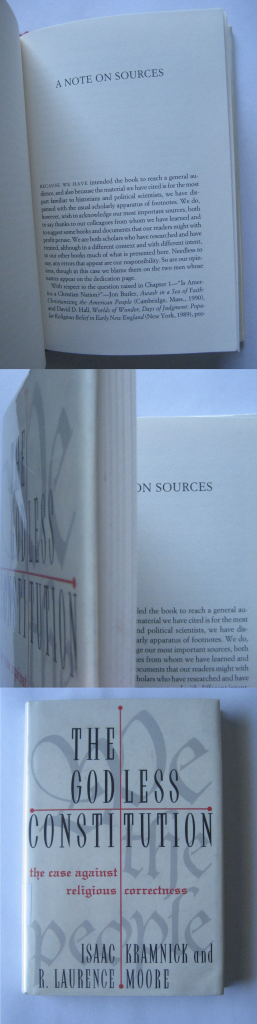
In the book "The Godless Constitution", written by Isaac Kramnick and J. Laurence Moore, the following is written about footnotes:
Because we have intended the book to reach a general audience, and because the material we have cited is for the most part familiar to historians and political scientists, we have dispensed with the usual scholarly apparatus of footnotes.

There's just one problem. It's up to us to prove that this is what the book actually states. Google Books has two entries, (1) (2) neither of which allow you see page 179, which is the page that this is on. You might get lucky and reference some other book on Google Books, if you're lucky enough to find the appropriate footnote. David Barton has shown this book and it's page in one of his numerous TV appearances, but unless you know specifically off hand which You Tube video to reference, you're stuck. (If it's even on You Tube to begin with)

So here it is, page 179: (click for larger)

Kramnick and Moore are outright arrogant. Their position is that "we know better than you, we don't need to prove anything to a peon like you, so you should just trust us because we have the credentials to prove our greatness and intellectual prowess".

No, I would rather not. You people in academia have proven without a shadow of a doubt that you cannot be trusted. But this does present us with what on the surface appears to be a tricky scenario. If the general reporting is to believed, educators are not paid nearly enough and we need to put more money into education. Without getting stuck on examples to the contrary, because there indeed are plenty of well paid educators out there, what is the interest of professors if it's not money? Benjamin Franklin explained this very clearly, at the Constitutional Convention:

There are two passions which have a powerful influence on the affairs of men. These are ambition and avarice; the love of power, and the love of money.

This is interesting, because we all have heard of the phrase "Follow the money". But how do we "Follow the power", to coin a phrase that's simple and straightforward comparative to it's cousin. I might have an idea:

The purpose of a university should be to make a son as unlike his father as possible.

That was stated by Woodrow Wilson, America's second no-holds-barred,(TR was first) pedal to the metal statist. Now on the surface, this quote could be taken innocently. "But what if the father is uneducated, or maybe stuck in a low level job?" Fortunately, I have the full transcript of that portion of Wilson's speech, and it's hardly innocent:

"The purpose of a university should be to make a son as unlike his father as possible," He said. "By the time a man has grown old enough to have a son in college he has specialized. The university should generalize the treatment of its undergraduates, should struggle to put them in touch with every force of life. Every man of established success is dangerous to society. His tendency is to keep society as it is. His success has been founded upon it. You will not find many reformers among the successful men.

So now perhaps we can achieve what we set out to do. In order to follow power, we have to ask "What is power?" and in doing so once we discover what a given goal is, we can follow it. The power to completely change society? That's power, and that's the interest that way too many professors have, regardless of the amount of money they can make. Could they make money off of their endeavors? Perhaps. But that's not guaranteed. What is guaranteed is the flexing of muscle and increase of power. Just as Benjamin Franklin stated. They are aspiring to their own ambitions.

It's important to understand what a college really is, not what they used to be. They used to be places where people went to learn a skill for their own betterment.(or for that matter, the people around them given the benefits of that the skill would create) Colleges is where our rulers are being groomed. It's where revolutionaries are being grown, by design. In this instance, Woodrow Wilson is not wrong. Kramnick and Moore's book is the fulfillment of Wilson's dreams.

http://tinyurl.com/c2k7xmg

Friday, April 26, 2013

Do you want to make government bigger? Try running it like a business.

A few days ago I wrote how Progressives proposed and ultimately turned the veto and budgeting process on its head, by taking that power away from congress and giving it to the executive, despite the fact that that's unconstitutional. There's an interesting fact wrapped up in all this. In "The decline and resurgence of Congress", by James L Sundquist, the following observations are made: (page 40)

When President Taft took office, he made budget reform a matter of major concern. Among other steps, he appointed a Commission on Economy and Efficiency; it recommended that the executive branch be required to prepare a single budget, and Taft in his last week in office did just that, submitting his own consolidated budget for the executive branch as an alternative to the book of estimates.

It's probably true that in many businesses, the chief executive is the one who does this. I wouldn't know, I've never run a Fortune 500 conglomerate, but I do feel confident in saying that it's not the people running the fryolator who are doing the budgets for McDonalds. As it pertains to the chief executive of the United States, this is not what the Founding Fathers said. Article 1, Section 7, Clauses 1 and 2 of the Constitution state the following:

1: All Bills for raising Revenue shall originate in the House of Representatives; but the Senate may propose or concur with Amendments as on other Bills.

2: Every Bill which shall have passed the House of Representatives and the Senate, shall, before it become a Law, be presented to the President of the United States; If he approve he shall sign it, but if not he shall return it, with his Objections to that House in which it shall have originated, who shall enter the Objections at large on their Journal, and proceed to reconsider it.

The Founders did not leave any room here. The House owns this task, as a constitutional matter anyways. On page 40 of Sundquist's book, he writes this:

By 1916, a pledge to introduce a "simple businesslike budget system" had found its way into the Republican platform(the Democrats only promised to consolidate appropriations responsibility in a single committee in each house of the Congress). Then came the explosive growth of government in World War 1, and the lack of management became intolerable. ... "The Government has been running wild, the ship has been rudderless, the captain has been off watch, and there has been no head who might be held responsible," declared Representative Martin B. Madden, Republican of Illinois, who served on the House Select Committee on the Budget.

This sounds very attractive, but every single person who will end up reading this has the benefit of 20/20 hindsight. Since the President and Congress passed their unconstitutional budgeting act which makes the President the source of the budget, has government gotten smaller or bigger?

It's gotten bigger. Much bigger. The Founding Fathers specifically delegated this power to congress as a way to divest power away from the President as a matter of preventing the rise of a new monarch, among other reasons. Culturally, this has created a scenario where the President gets to set the tone, not congress who is much closer to we the people. Naturally, this leads to bigger government just by observing it and thinking about what would happen. It's no wonder the progressives wanted this to be the case, what do progressives always want? Bigger government. So logically it follows.

I suppose I have probably kicked a hornets nest with this because the modern conventional wisdom is that government isn't run like a business and that's precisely the problem. Well, that sentiment is simply hogwash, and I'm going to use none other than Woodrow Wilson to prove my case:

Jefferson wrote of “the laws of Nature”—and then by way of afterthought—“and of Nature’s God.” And they constructed a government as they would have constructed an orrery—to display the laws of nature. Politics in their thought was a variety of mechanics. The Constitution was founded on the law of gravitation. The government was to exist and move by virtue of the efficacy of “checks and balances.”

The trouble with the theory is that government is not a machine, but a living thing. It falls, not under the theory of the universe, but under the theory of organic life. It is accountable to Darwin, not to Newton. It is modified by its environment, necessitated by its tasks, shaped to its functions by the sheer pressure of life. No living thing can have its organs offset against each other, as checks, and live. On the contrary, its life is dependent upon their quick co-operation, their ready response to the commands of instinct or intelligence, their amicable community of purpose. Government is not a body of blind forces; it is a body of men, with highly differentiated functions, no doubt, in our modern day, of specialization, with a common task and purpose. Their co-operation is indispensable, their warfare fatal.

Woodrow Wilson means this as a way to undermine the Constitution, and he is 100% wrong. But apply these words to most businesses, and you have largely accurate statements. No business could survive a system of "checks and balances". How quickly would Google go out of business if Google's research and development department was constantly in an active state of warfare against Google's marketing department? That would be a suicidal way to run a business. I know that plenty of businesses have departments which have their differences, but I mean as an active "first order of business" policy going forward.

Here's the problem. In a lot of ways, modern business is constructed like a totalitarian state. Internally, you're dealing largely with an oligarchy.(sometimes, a monarch) Which is a good thing for an entity which has little to no effect upon the people who in the end only buy it's products or services. But in government, you want checks and balances. You do not want a well oiled machine controlling the levers of power and the laws of the nation. Take a look around the world, where do you see such a government? Communist China. The Soviets were very capable of "getting things done". Venezuela. You could probably name most of them, actually.

Businesses largely are "living things" in that they do have living constitutions that are "shaped to its functions by the sheer pressure of life". What the Founders gave us is not. It's set in stone, because they believed that liberty is timeless.

History has shown that the only way Liberty can thrive is when government is slowed down. Not just slowed down a little bit, massively slowed down. That's partially what the Constitution does. But if a business was slowed down massively, it probably would not survive. So the next time you say to yourself "I wish government could be run more like a business", be careful what you wish for. You just might get it, and you probably won't like what you get considering that we are already partially down that path. So far, it's not looking very good.

http://tinyurl.com/c6b6fn6