Saturday, December 6, 2014

Upton Sinclair's letter of deception about Sacco and Vanzetti

Upton Sinclair's 1929 letter to John Beardsley

Dear John:

I will write you a few notes about the matter concerning which we were talking last night.

When I went to Boston the last time in October 1928 I was completely naive about the Sacco-Vanzetti case, having accepted the defense propaganda entirely. But I very quickly began to sense something wrong in the situation. There was an air of mystery about the Boston anarchists, and I saw they had something to conceal. Then in Sacco's cross examination I detected what seemed to be a slip in his alibi. I began asking catch questions, and ultimately I got the admission from one of the leading defense witnesses that his testimony had been framed. I got a virtual admission of the same thing from another witness. It became certain to me that Sacco at least had been concerned in the dynamitings which had occurred in New England just after the war, and I supposed that this was what was being hidden from me. I remained of the opinion that both men had been unquestionably innocent of the crime of which they were accused. Their trial had manifestly not been a fair one, and on that basis I was prepared to defend their right to a new trial. That was my state of mind at the time that I agreed with The Bookman for the serial publication of "Boston".

But on my way to Denver, where I had arranged by telegraph to meet Fred Moore, I turned the matter over in my own mind, and doubts began to assail me. Alone in a hotel room with Fred I begged him to tell me the full truth. His reply was "first tell me what you have got." I decided to take a chance at the worst, and I told him that I knew that the men were not merely terrorists, but that they were guilty of the holdup. His reply was, "Since you have got the whole story there is no use my holding anything back," and he then told me that the men were guilty, and he told me in every detail how he had framed a set of alibis for them. He said that there were quite a group of terrorist anarchists who had been supporting the movement by various kinds of pay-roll holdups, and that all the practises were well known to Carlo Tresca and Gurley Flynn.

This naturally sent me into a panic. I telegraphed Seward Collins of The Bookman saying that I could not write the book, and I cabled half a dozen translators and publishers abroad canceling arrangements which I made for serial publication. But on my way to Los Angeles I thought the matter over, and I realized certain facts about Fred Moore. I had heard that he was using drugs. I knew that he had parted from the defense committee after the bitterest of quarrels. Sacco in a letter had addressed him as, "your implacable enemy." Moore admitted to me that the men, themselves, had never admitted their guilt to him; and I began to wonder whether his present attitude and conclusions might not be the result of his broodings on his wrongs. The first thing I did when I got to Los Angeles was to see Lola Moore, Fred's former wife, who had divorced him. She had been all through the four or five years of the case with him, and she expressed the greatest surprise, when I told her of Fred's conclusion, saying that he had most positively not been of that opinion when he had dropped the case and left Boston.

I faced the most difficult ethical problem of my life at this point. I had come to Boston with the announcement that I was going to write the truth about the case. If I had dropped the project it would have been universally said and believed that it was because I had decided the men were guilty. I had, of course, no first hand knowledge of their guilt, but I did have first hand knowledge of the framing of testimony. I decided that I would write the story on the basis of telling exactly what I knew. I would portray all sides, and show all the different groups and individuals telling what they knew and what they believed. I would take my stand on the point that the men had not been proved guilty, and that their trial had not been fair. That was all that the law required in order to prevent the execution, and it was all that my thesis required.

I put the problem up to Floyd Dell who happened to come out here, and he read the chapters which I had so far completed, and said that what I was doing was exactly correct. Of course, word spread among the committee in Boston what I was doing, and they flew into a panic, and I had a long string of horrified and indignant letters and telegrams. They strenuously denied that there had ever been any perjury in the case - which, of course, I knew to be perfectly absurd. They also denied that Sacco had ever been a terrorist -- though on this point I was finally able to back Gardner Jackson down. I saw him in New York before the book went to press, and we went all over various scenes line by line, and argued for hours. Gardner admitted that I was all right about Sacco, but he claimed that I was doing Vanzetti an injustice. Charles Boni had listened to our discussion. I asked him his opinion, and he said that Gardner had admitted everything that I was claiming, and a little more. Vanzetti as a pacifist was a perfect absurdity, because I talked with a Socialist whom he had chased with a revolver, and young Brini told me of having witnessed a similar scene as a child in his home.

The rumors of Sacco's guilt were very general in the Italian colony in Boston, and there is no possible question that these rumors, brought to Thayer and Fuller and Lowell in a thousand forms by the police, were the real reason for the execution. When I was in New York last fall I made another effort to satisfy my own mind about the problem. I asked Roger Baldwin, who is, himself, an anarchist, and knows the whole crowd. He told me there was no possible doubt of the guilt of Sacco and Vanzetti, and that the militant anarchists had financed themselves that way for years, both here and abroad. They never took the money for themselves, but only for the movement, and this constituted them idealists and heroes from the point of view of extreme class war theories.

I then took this proposition to Robert Minor, who was an anarchist up to the time of the Russian revolution, and who knows the whole movement. Bob said that he had heard these rumors from the beginning, and had investigated them carefully, and was convinced that they were not true about Sacco and Vanzetti. He says he has never known a class war case of this sort in which there were not similar rumors, and people who will tell you all about it from the "inside." Sometimes they are started by police agents and sometimes by a certain type of weak minded person who takes a pleasure in having the real inside story about a sensational mystery.

So you see that in the end I don't really know any more about the thing than I did in the beginning, and can only take my stand as I did in "Boston", upon the thesis that men should not be executed upon anybody's rumors.

This letter is for yourself alone. Stick it away in your safe, and some time in the far distant future the world may know the real truth about the matter. I am here trying to make plain my own part in the story, and the basis of my seemingly controdictory moods and decisions.

Sincerely,

Upton Sinclair

http://tinyurl.com/o4k59zm

Sunday, November 23, 2014

Who polluted Robin Hood?

Robin Hood was not a jacobin nor a socialist, robbing from the rich and giving to the poor. But here, I will highlight where he was transformed into one.

The title of the book is: "Robin Hood: A Collection of All the Ancient Poems, Songs, and Ballads, Now Extant Relative to that Celebrated English Outlaw ; to which are Prefixed Historical Anecdotes of His Life", authored by Joseph Ritson, who was sympathetic to Jacobinism. This book was first printed in 1795. This book is a collection of his works, which means that he was spreading this filth around in who knows how many publications in how many countries prior to collecting them. Ever wonder why now, that idea of Robin Hood as a communist is so widespread? This is why.

About Ritson's Jacobin viewpoint, see "Joseph Ritson: a critical biography", by Henry Alfred Burd. P. 177 (here)

Previous to this, most old stories of Robin Hood had him stealing from the Sheriff of Nottingham(Child Ballad 122), or, from characters such as The Bishop of Hereford. (Child Ballad 143; alt) There are a few outliers, such as Martin Parker's Ballad(154), which Ritson cites, but it was Ritson who mainstreamed this idea where no longer do the Sheriff or King John get rich via taxes, and instead, it is Robin Hood who does the redistributing.

Now, for a small examination of Ritson's writing, particularly page xlvii:

In a word, every man who has the power has also the authority to pursue the ends of justice, to regulate the gifts of fortune, by transfering the superfluities of the rich to the necessities of the poor; by relieving the oppressed, and even, when necessary, destroying the oppressor. These are the objects of the social union, and every individual may, and to the utmost of his power should, endeavour to promote them.

This kind of language seems very familiar. Who does that sound like to you?

http://tinyurl.com/nx23zuq

Friday, November 7, 2014

Edward Ross explains his resignation from Stanford University

Following the (at the time) infamous "Ross Affair", Professor Edward Ross had this to say about his resignation:
At the beginning of last May a representative of organized labor asked Dr. Jordan to be one of the speakers at a mass meeting called to protest against coolie immigration, and to present 'the scholar's view.' He was unable to attend, but recommended me as a substitute. Accordingly, I accepted, and on the evening of May 7th read a twenty-five minute paper from the platform of Metropolitan Hall in San Francisco. . . . I tried to show that owing to its high, Malthusian birth rate the Orient is the land of 'cheap men,' and that the coolie, though he can not outdo the American, can underlive him. I took the ground that the high standard of living that restrains multiplication in America will be imperiled if Orientals are allowed to pour into this country in great numbers before they have raised their standard of living and lowered their birth rate. I argued that the Pacific is the natural frontier of East and West, and that California might easily experience the same terrible famines as India and China if it teemed with the same kind of men. In thus scientifically co-ordinating the birth rate with the intensity of the struggle for existence, I struck a new note in the discussion of Oriental immigration which, to quote one of the newspapers, 'made a profound impression.' On May 18th, Dr. Jordan told me that quite unexpectedly to him Mrs. Stanford had shown herself greatly displeased with me, and had refused to re appoint me. He had heard from her just after my address on coolie immigration. He had no criticism for me and was profoundly distressed at the idea of dismissing a scientist for utterances within the scientist's own field. He made earnest representations to Mrs Stanford, and on June 2d I received my belated re-appointment for 1900-1. The outlook was such, however, that on June 5th I offered my resignation.

When I handed it in Dr. Jordan read me a letter which he had just received from Mrs. Stanford and which had, of course, been written without knowledge of my resignation. In this letter she insisted that my connection with the university end, and directed that I be given my time from January 1st to the end of the academic year. My resignation was not acted upon at once, and efforts were made by President Jordan and the president of the board of trustees to induce Mrs. Stanford to alter her decision. These proved unavailing, and on Monday, November 12th, Dr. Jordan accepted my resignation in the following terms:

'I have waited till now in the hope that circumstances might arise which would lead you to a reconsideration. As this has not been the case, I, therefore, with great reluctance, accept your resignation, to take effect at your own convenience. In doing so I wish to express once more the high esteem in which your work, as a student and a teacher, as well as your character as a man, is held by all your colleagues.'

Last year I spoke three times in public - once before a university extension centre on 'The British Empire,' once before a church on 'The Twentieth Century City,' and once before a mass-meeting on coolie immigration. To my utterances on two of these occasions objection has been made. It is plain, therefore, that this is no place for me. I can not with self-respect decline to speak on topics to which I have given years of investigation. It is my duty as an economist to impart, on occasion, to sober people, and in a scientific spirit, my conclusions on subjects with which I am expert, and if I speak I can not but take positions which are justified by statistics and by the experience of the Old World. . . . I am sorry to go, for I have put too much of my life into this university not to love it. My chief regret in leaving is that I must break the ties that bind me to my colleagues of seven years, and must part from my great chief, Dr. Jordan.

Saturday, November 1, 2014

Henri de Saint-Simon and Technocracy

In "The Coming Of Post-industrial Society", Daniel Bell writes the following: (Page 76-77)
Industrial Society, as St. Simon insisted, was the application of technical knowledge to social affairs in a methodical, systematic way. With industrial society, thus, has come the technicien - the French usage is more apt than the English "technician," for its sense in French is much wider - the trained expert in the applied sciences. It has implied, too, that those who possessed such knowledge would exercise authority - if not power - in the society.

St. Simon's vision of industrial society, a vision of pure technocracy, was a system of planning and rational order in which society would specify its needs and organize the factors of production to achieve them. Industrial society was characterized by two elements, knowledge and organization. Knowledge, he said, was objective. No one had "opinions" on chemistry or mathematics; one either had knowledge or not. The metaphors St. Simon used for organization were an orchestra, a ship and an army, in which each person fulfils a function in accordance with his competence. Although St. Simon clearly outlined the process wherby a nascent bourgeoisie had superseded the feudal nobility, and though he predicted the rise of a large working class, he did not believe that the working class would succeed the bourgeoisie in power. As he tried to show in his sketch of historical development, classes do not rule, for society is always governed by an educated elite. The natural leaders of the working class would therefore be the industrialists and the scientists. He forsaw the dangers of conflict, but did not regard it as inevitable. If an organic society were created, men would accept their place as a principle of justice. The division of labor meant that some men would guide and others would be guided. In a society organized by function and capacity, doctors and engineers and chemists would employ their skills according to objective needs, not in order to gain personal power. These men would be obeyed not because they are masters but because they have technical competence; to be obedient to one's doctor, after all, is a spontaneous but rational act. For this reason the St. Simonians, in a set of phrases that later were used by Engels, gave their new social hierarchy the slogan, "From each according to his capacity, to each according to his performance," and the industrial society, as they describe it, was no longer the "rule over men, but the administration of things."

The administration of things - the substitution of rational judgement for politics - is the hallmark of technocracy.

Saturday, September 27, 2014

William Thomas Stead personally taught "Government by Journalism" to William Randolph Hearst

If you are someone who is upset about the state of Journalism today, and the one-sided ideological view that they take on every issue, then the essay "Government by Journalism" will be a real eye opener for you.

But William Thomas Stead was not content only with manipulating his readers through his one single paper, the Pall Mall Gazette, Stead looked for someone who would truely bring his idea to new heights - manipulate readers in greater numbers than he could ever possibly reach. He said:

I have been long on the look out for a man to appear who will carry out my ideal of government by journalism

This is how the interview begins, then Stead explains to Hearst in greater detail:

I am certain that such a man will come to the front some day, and I wonder if you are to be that man. You have many of the qualities such a man must possess. You have youth, energy, great journalistic flaire, adequate capital, boundless ambition - yes, you have all these. But - but, I am not sure you have got a soul, and if you have not a soul all the other things are as nothing

This notion of Hearst "having a soul" is very important, but I'll get to it at the bottom. As for the rest of this paragraph, Stead is absolutely convinced that Hearst is the best man for the job in regards to Government by Journalism. So what is this "Government by Journalism"? In Stead's own writing, in a paragraph specifically written about journalists, Stead writes that:

They decide what their readers shall know, or what they shall not know.

Sound familiar? Stead even gives an example of how this works, right after that line. He writes:

One man is a favourite with the press, and his speeches are reported in the first person. Another man has offended the reporters or the editor, and his remarks are cut down to a paragraph.

They do this today to Sarah Palin, Ted Cruz, and many others. It was Stead who was the pioneer in this, and he exported his ideas to America via William Randolph Hearst. So now that you have an idea of what Government by Journalism is, what else did Stead say in regard to his meeting with Hearst?

After I returned home and was settling down to work I was startled by receiving every now and then from Mr. Hearst cablegrams addressed to his London correspondent asking him to obtain and to telegraph what I thought upon what the Journal was doing in this, that, or the other direction. I do not for a moment argue post hoc propter hoc, but it was almost immediately after that midnight talk that Mr. Hearst began to realise the ideal of a journalism that does things. He took up the question of municipal ownership. He engaged Arthur Brisbane, the son of Brisbane the Fourierist, to write editorials. He began the battle against the Trusts; he made the Spanish-American war. For weal or for woe Mr. Hearst had found his soul; for weal or for woe he had discovered his chart and engaged his pilot, and from that day to this he has steered a straight course, with no more tackings than were necessary to avoid the fury of the storm.

That paragraph is explained by these two comments from Hearst: (from the interview section)

"Journalism is only a business, like everything else!"

This is very important to understand. William Thomas Stead single handedly changed Hearst's mind. At the beginning of the interview, Hearst walked in with dollar signs in his eyes. But at the end of the interview:

"It's very interesting what you say," replied Mr. Hearst. "It never occurred to me in that light before."

After the interview Hearst now viewed his papers as places to influence policy positions, and the rest is what I quoted above, from engaging the Trusts to Municipal Ownership and more.

This is where the part about having a soul comes in. What did having a soul mean to William Thomas Stead? He explains:

But in the inmost soul of him–and he has a soul and has found it–there is a desire to serve the common people. He is a Jeffersonian Democrat, a natural demagogue, and a man who is proud of being the tribune of the people.

Demagoguery is the core of having a soul. Stead tries to cast this as "being in service" to the common people, yet the whole scheme is a fraud and is nothing more than a journalist being in service to their own policy preferences.

I have written extensively about how Walter Lippmann is the "Father of Modern Journalism" (here and here), and was also a "brilliant" manipulator of public opinion. But who would be the Grandfather of Modern Journalism? I believe that to be William Thomas Stead.

He laid the foundation upon which so many of their tactics rest today. In "The Future of Journalism" Stead explains how journalists can regiment themselves around certain people(See starting with paragraph 11), not just to gather certain information but to impart it from the inside. It's top to bottom manipulation, this goes much deeper than just the reporting you see or hear. "The Future of Journalism" was a follow up essay for "Government by Journalism" - this second one is geared more toward the implementation of achieving those goals.

Stead created the idea, and had some success in its implementation, but it was Hearst - Hearst was the vehicle for the mass use and implementation, as well as the vehicle for importing all of this from Britain and into America. Lippmann merely finished the job and perfected it.

Sunday, September 14, 2014

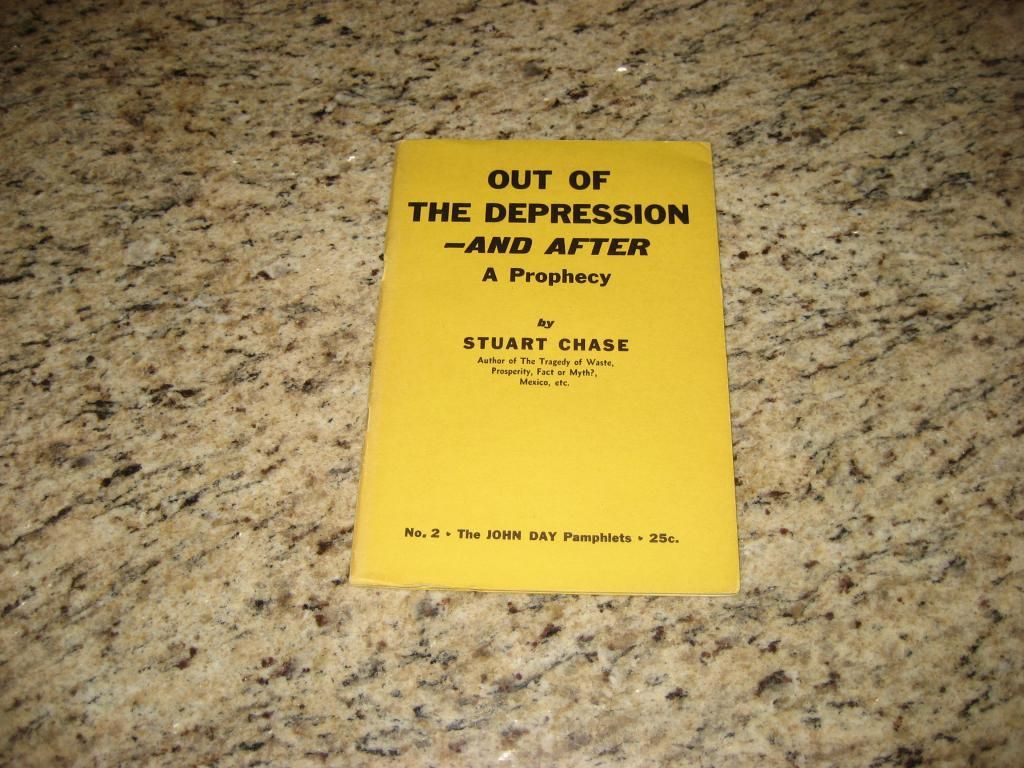
John Day pamphlets

I have found this series to be intriguing, now that I own one. This pamphlet series is 45 publications long, it ran from 1932 to 1934. They are as follows: (author, title)

1: Rebecca West, Arnold Bennett Himself

2: Stuart Chase, Out of the Depression--and After: A Prophecy

3: Joseph Vissarionovich Stalin, The New Russian Policy: June 23, 1931

4: Norman Edwin Himes, The Truth about Birth Control: With a Bibliography of Birth Control Literature

5: Walter Lippmann, Notes on the Crisis

6: Charles Austin Beard,The Myth of Rugged American Individualism

7: Rexford Guy Tugwell, Mr. Hoover's Economic Policy

8: Herman Hagedorn, The three pharaohs: a dramatic poem

9: Marion Hawthorne Hedges, A Strikeless Industry: A Review of the National Council on Industrial Relations for the Electrical Construction Industry

10: Gilbert Seldes, Against Revolution

11: George Sylvester Counts, Dare the School Build a New Social Order? (Special, 56 pages)

12: Hendrik Willem Van Loon, To Have or to Be--Take Your Choice

13: Norman Thomas, The Socialist Cure for a Sick Society

14: Herbert George Wells, What Should be Done -- Now: A Memorandum on the World Situation

15: Victor Francis Calverton, For Revolution

16: Horace Meyer Kallen, College Prolongs Infancy

17: Richard Bartlett Gregg, Gandhiism versus Socialism

18: Pearl Sydenstricker Buck, Is There a Case for Foreign Missions?

19: Stuart Chase, Technocracy: An Interpretation

20: Albert Einstein, The Fight Against War. Edited by Alfred Lief. (Special, 64 pages)

21: Arthur Gordon Melvin, Education for a New Era: a Call to Leadership

22: John Strachey, Unstable Money

23: Ambrose William Benkert and Earl Harding, How to Restore Values: The Quick, Safe Way Out of the Depression

24: Everett Ross Clinchy, The Strange Case of Herr Hitler

25: Walter Lippmann, A New Social Order

26: Elwyn Brooks White, Alice Through the Cellophane

27: Osgood Nichols and Comstock Glaser, Work Camps for America

28: Louis Morton Hacker, The Farmer is Doomed

29: Archibald MacLeish, Frescoes for Mr. Rockefeller's City

30: Committee of the Progressive Education Association on Social and Economic Problems, A Call to the Teachers of the Nation

31: Henry Hazlitt, Instead of Dictatorship

32: Stuart Chase, The Promise of Power

33: Matthew Josephson, Nazi Culture: The Brown Darkness Over Germany

34: Maurice Finkelstein, The Dilemma of the Supreme Court: Is the N.R.A. Constitutional?

35: Lev Davydovič Trockij (Leon Trotsky), What Hitler Wants

36: Audacity! More Audacity! Always Audacity!, Published in Cooperation with The United Action Campaign Committee

37: Harold Rugg and Marvin Krueger, Study Guide to National Recovery: An Introduction to Economic Problems

38: Bertram David Wolfe, Marx and America

39: Marquis William Childs, Sweden: Where Capitalism is Controlled

40: Sir Arthur Salter, Toward a Planned Economy

41: Edward Albert Filene, The Consumer's Dollar

42: Rev. John Haynes Holmes, Is Suicide Justifiable?

43: Mary Catherine Philips and Frederick John Schlink, Discovering Consumers

44: James Rorty, Order on the Air!

45: Stuart Chase, Move the Goods!

http://tinyurl.com/oqxknp4

Update:

Here are all the ones I can find for current reading:

1: Rebecca West, Arnold Bennett Himself

6: Charles Austin Beard,The Myth of Rugged American Individualism (page 13-22)

7: Rexford Guy Tugwell, Mr. Hoover's Economic Policy

9: Marion Hawthorne Hedges, A Strikeless Industry: A Review of the National Council on Industrial Relations for the Electrical Construction Industry

11: George Sylvester Counts, Dare the School Build a New Social Order? (Special, 56 pages)

15: Victor Francis Calverton, For Revolution

16: Horace Meyer Kallen, College Prolongs Infancy

17: Richard Bartlett Gregg, Gandhiism versus Socialism

19: Stuart Chase, Technocracy: An Interpretation

24: Everett Ross Clinchy, The Strange Case of Herr Hitler

24: Everett Ross Clinchy, The Strange Case of Herr Hitler (alt)

30: Committee of the Progressive Education Association on Social and Economic Problems, A Call to the Teachers of the Nation

31: Henry Hazlitt, Instead of Dictatorship

32: Stuart Chase, The Promise of Power

34: Maurice Finkelstein, The Dilemma of the Supreme Court: Is the N.R.A. Constitutional?

36: Audacity! More Audacity! Always Audacity!, Published in Cooperation with The United Action Campaign Committee

37: Harold Rugg and Marvin Krueger, Study Guide to National Recovery: An Introduction to Economic Problems

38: Bertram David Wolfe, Marx and America

41: Edward Albert Filene, The Consumer's Dollar

43: Mary Catherine Philips and Frederick John Schlink, Discovering Consumers

45: Stuart Chase, Move the Goods!

Saturday, September 13, 2014

An old, almost impossible to find pamphlet of progressivism

It's here!

For the most part, I have had a lot of success rifling through the progressives' history via the internet, but if we really want to dig up dirt on these people we need an even greater availability of their words - easily accessible.

I will at some point scan this in, into PDF form for general reading. For now, I do not have the time to do the scanning and conversion that will be necessary. But it's just another thing to look forward to!

These people, these progressives, do not want their history to be seen, which is why we must shine the light. I happen to believe that their history is their greatest weakness.

There are other books currently not visible online which contain more pertinent content than this does, but this still helps to create a more full picture of what we face.